Opis
Praca stanowi podsumowanie badań nad florą mchów grupy Policy w Beskidzie Wysokim. Oparta jest przede wszystkim na materiałach zielnikowych. Ogółem na badanym terenie stwierdzono występowanie 264 gatunków i 5 odmian, co stanowi około 38% muskoflory Polski. Należą one do 43 rodzin, z których najliczniej reprezentowane są: Brachytheciaceae (23 gatunki), Dicranaceae (20 gatunków), Pottiaceae (19 gatunków i 1 odmiana), Bryaceae (19 gatunków), Amblystegiaceae i Sphagnaceae (po 18 gatunków) oraz Hypnaceae (16 gatunków i 3 odmiany). Analiza częstości występowania wykazała, że największą grupę stanowią taksony bardzo rzadkie (36,4%), następnie rzadkie (20,8%), dość częste (17,1%), częste (14,5%) i pospolite (11,2%). Biorąc pod uwagę siedliska występowania mchów stwierdzono, że największą grupę stanowią gatunki naziemne (122), następnie epilityczne (120), bagienne (54), epi. tyczne (52), epiksyliczne (38) i wodne (15). We florze Policy zaznacza się liczna grupa mchów objętych ochroną prawną oraz zagrożonych w Polsce i w Europie. Informacje o tych mchach zestawiono w tabeli 2. Polica nie posiada żadnych endemicznych taksonów mchów. Do tej pory nie stwierdzono także żadnych gatunków, które na terenie Polski występowałyby tylko na omawianym terenie. Regionalnie w Beskidach Zachodnich tylko w paśmie na Policy rosną Niphotrichum ericoides (Brid.) Bednarek-Ochyra & Ochyra i Splachnum ampullaceum Hedw.
Książka tylko w języku angielskim.
TABLE OF CONTENTS
I. Introduction
II. Study area
III. Bryological research in the Police Range
IV. General characterization of the moss flora
V. Ecological analysis of the moss flora
- Terrestrial mosses
- Epiphytic mosses
- Epixylic mosses
- Epilithic mosses
- Paludicolous mosses
- Aquatic mosses
VI. The occurrence of mosses in plant communities
VII. Mosses and the nature conservation
VIII. Systematic list of moss taxa
IX. Doubtful and excluded species
Acknowledgements
References
Appendix: Distribution maps for moss taxa
I. INTRODUCTION
Bryological investigations carried out in the Polish Carpathians for almost 200 years provided information on the distribution and ecology of mosses in most important ranges of these mountains, including the Bieszczady Zachodnie Range in the Eastern Carpathians (Lisowski 1956), Beskid Sądecki (Mamczarz 1977), Pieniński Pas Skałkowy (Szafran 1952; Ochyra 1984b), partially the Beskid Niski (Wacławsiak 1957; Karczmarz 1979, 1987; Stebel & Ochyra 2000), Gorce (Lisowski & Kornas 1966; Stebel 2004a), Babia Góra (Stebel 2000, 2004b), Tatras (Chałubiński 1886; Lisowski 1959, 1965; Ochyra & Ciszto 1999), Beskid Mały (Szafran 1965; Stebel & Stebel 1998), and Beskid Śląski (Szafran 1965; Plášek & Stebel 2002). The present account is the next monograph referring to the Polica, an important range from a bryogeographical viewpoint forming part of the Beskidy Zachodnie Mts.
II. STUDY AREA
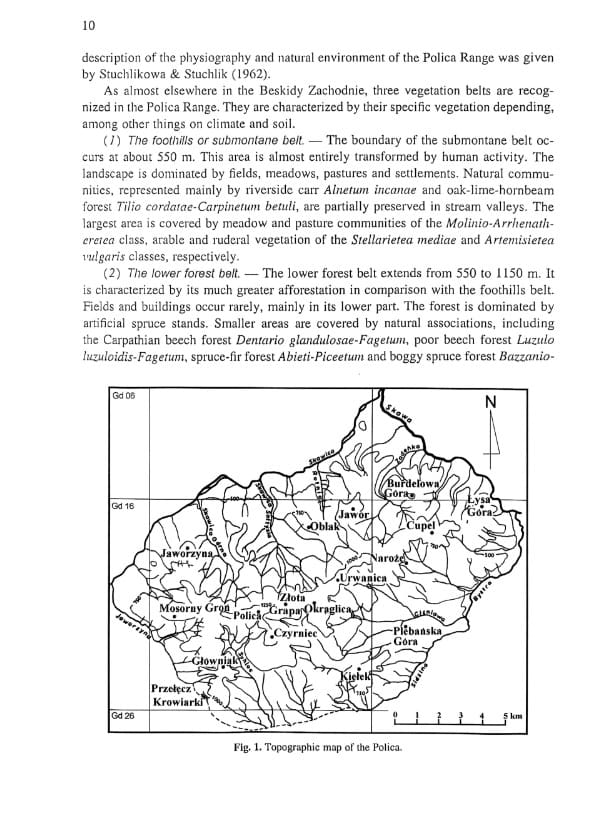
The Polica form an eastern part of the Babia Góra massif which belongs to the Beskid Wysoki – the highest part of the Beskidy Zachodnie Mts (Kondracki 1978, 1994). Its border is delimited by the rivers Skawa in the north-east and Bystrzanka in the south-east. It is then arbitrarily delimited from Sidzina through Zubrzyca Górna to the valley of the Syhlec stream and subsequently runs along this valley to the Krowiarki Pass. The south-western border from the Krowiarki pass to Zawoja-Widły is formed by the valley of the Jaworzyna stream, from where it follows the Skawica river to its confluence with the Skawa river (Fig. 1). The highest point of the range is Mt Polica (1368.7 m) and the lowest (371.2 m) at the meeting of the Skawica and Skawa rivers. The Polica Range is situated between 19°31′43″ and 19°47′08″ E and 49°34′21″ and 49°42′31″ N. It covers an area of approximately 156 sq. km.
A mountain climate is dominant in the Polica Range, as in the whole Beskidy Zachodnie, its parameters changing according to altitude. The average annual temperature in Zawoja (670 m) is 6.4°C, in Stańcowa (850 m) 5.7°C and in Markowe Szczawiny (1180 m) 3.7°C. The precipitation also shows a clear dependence on altitude and aspect. The average values are as follows: in Zawoja (N slopes) 1139.0 mm, in Stańcowa (S slopes) 1086.4 mm, and in Markowe Szczawiny (N slopes) 1409.0 mm (Obrębska-Starklowa 1963). The basic types of rock forming the Polica Range are the so-called Magura sandstones. They are acidic rocks, but sometimes with remarkable additions of calcium carbonate. Most soils are also strongly to moderately acidic. A detalied
description of the physiography and natural environment of the Polica Range was given by Stuchlikowa & Stuchlik (1962).
As almost elsewhere in the Beskidy Zachodnie, three vegetation belts are recognized in the Polica Range. They are characterized by their specific vegetation depending, among other things on climate and soil.
(1) The foothills or submontane belt. — The boundary of the submontane belt occurs at about 550 m. This area is almost entirely transformed by human activity. The landscape is dominated by fields, meadows, pastures and settlements. Natural communities, represented mainly by riverside carr Alnetum incanae and oak-lime-hornbeam forest Tilio cordatae-Carpinetum betuli, are partially preserved in stream valleys. The largest area is covered by meadow and pasture communities of the Molinio-Arrhenatheretea class, arable and ruderal vegetation of the Stellarietea mediae and Artemisietea vulgaris classes, respectively.
(2) The lower forest belt. — The lower forest belt extends from 550 to 1150 m. It is characterized by its much greater afforestation in comparison with the foothills belt. Fields and buildings occur rarely, mainly in its lower part. The forest is dominated by artificial spruce stands. Smaller areas are covered by natural associations, including the Carpathian beech forest Dentario glandulosae-Fagetum, poor beech forest Luzulo luzuloidis-Fagetum, spruce-fir forest Abieti-Piceetum and boggy spruce forest Bazzanio-Piceetum. By streams and in boggy places Alnetum incanae and Caltho-Alnetum occur. In deforested areas called glades (‘polany’) or mountain pastures (‘hale’) non-forest vegetation develops in communities such as Gladiolo-Agrostietum and Hieracio-Nardetum play a dominating role. In wet places and flushes there are fen communities, mainly Valeriano-Caricetum flavae and Carici canescentis-Agrostietum caninae. In the vicinity of Zubrzyca Górna small areas are covered by ombrotrophic bogs of the Oxycocco-Sphagnetea class.
(3) The upper forest belt. — Here the dominant association is Plagiothecio-Piceetum spruce forest. In deforested places there are meadow communities, mainly Hieracio-Nardetum and Gladiolo-Agrostietum. Now, because of declining use, most glades are at various stages of succession. Considerable areas are overgrown by Vaccinium myrtillus, Calamagrostis arundinacea, Rubus idaeus and young Picea abies. On steep rock bluffs on the northern slopes of Złota Grapa cliff shrub communities have developed dominated by such species as Salix silesiaca, S. caprea, Sorbus aucuparia and Lonicera nigra. Near the summit of Mt Polica shrubs of Pinus mugo occur, but this species was introduced here (Stuchlikowa & Stuchlik 1962). On the northern slopes of Mt Polica, in springs of the Skawica Górna stream patches of associations of the Montio-Cardaminetea class have developed.
A detailed description of the vegetation cover of the Polica was given by Stuchlikowa (1967, 1972, 1979) and Stuchlik (1968a, b).
III. BRYOLOGICAL RESEARCH IN THE POLICA RANGE
The first information on mosses of the Polica was published in the 1960s and 1970s in the phytosociological papers of Stuchlikowa (1967, 1972, 1979) and Stuchlik (1968a, b). At that time mosses of the area were also intensively collected by Dr M. Kuc, then a scientific worker of the Institute of Botany of the Polish Academy of Sciences in Kraków, but details of his collections have never been published. In the late 1970s intensive bryological studies in the area were made by R. Ochyra and L. Stuchlik (Ochyra 1980a, b, 1981a, b, 1984a). In the 1980s rich collections of bryophytes were made by J. B. Parusel during his phytosociological research of mainly forest communities. Numerous floristic data taken during these studies were published in various parts of the Atlas of the geographical distribution of mosses in Poland (Bednarek-Ochyra et al. 1990a, b, c, d, e, 1994a, b; Ochyra & Szmajda 1983; Ochyra et al. 1985a, b; Ochyra et al. 1988; Ochyra et al. 1990; Szmajda et al. 1991; Ochyra et al. 1992).
Some data on mosses of the Polica can also be traced in the works of Zarzycki (1956), Bielczyk (1986), Bednarek-Ochyra (1995) and Ochyra et al. (1999). In 1997 some moss species collected in this area by J. Żarnowiec, H. Klama and A. Stebel were distributed in Musci macroregioni meridionali Poloniae exsiccati (Jędrzejko et al. 1997a, b, c, d; Stebel et al. 1997a, b, c; Żarnowiec et al. 1997a, b, c, d, e). Finally, in 1999–2001, mosses of the Polica were investigated by A. Stebel and some records were published in his contribution to the moss flora of the Babia Góra massif (Stebel 2000). Unfortunately, some species reported in that account from the Babia Góra massif were in fact collected from the Polica because of changes in the boundary separating the Polica and Babia Góra. Then, the Zawoja–Zubrzyca Górna road was considered to be the boundary between these mountain groups but now it is accepted that it runs along the Jaworzyna and Syllec streams.
Wydawnictwo Sorus,
DM Sorus sp. z o.o.,
Bóżnicza 15/6,
60-643 Poznań,
Poland,
sorus@sorus.pl,
tel. +48 61 653 01 43











Opinie
Nie ma jeszcze żadnych recenzji