Opis
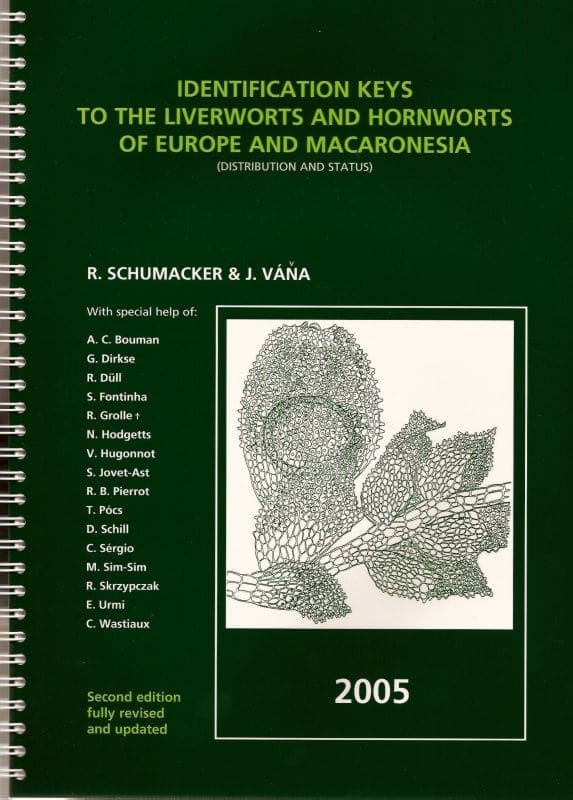
The first edition of the Identification Keys to Liverworts and Hornworts of Europe and Macaronesia published in 2000 was very successful: some 400 copies were sold. Thanks to comments, remarks, questions of many users encountering difficulties – especially in the keys to genera or in some keys for large genera, from students, beginners, experimented hobby – and professional bryologists, as to recently published books and papers, we started since 2003 to prepare a 2nd fully revised and updated edition.
This 2nd edition, carrefully edited by SORUS/Poznań, provides, a.o., new (or partly new) keys for Conocephalum, Fossombronia, Herbertus, Lepidozia, Lophozia, Plagiochila, Riccia, Scapania, Telaranea, etc., numerous new keys for subspecies or varieties, updated distribution data, many corrections to patronyms, an impressive number (ca. 300!) of new synonyms in the corpus as in the index and many new useful references to literature and illustrations until August 2005.
The book is provided with a metallic spiral binding.
Order from Europe
Czy prezentowany klucz do oznaczania glewików i wątrobowców posiada także informacje o ich występowaniu oraz rysunki ułatwiające identyfikację cech lub gatunków?
Czy jest to publikacja zawierająca wyłącznie klucze? Informacje chorologiczne i graficzne ułatwiają rozpoznawanie gatunków, co dla osób początkujących w poznawaniu tej grupy roślin jest dużym ułatwieniem.
Książka zawiera przede wszystkim klucze do oznaczania wszystkich rodzajów i gatunków wątrobowców i glewików występujących w Europie i Makaronezji według aktualnego stanu wiedzy. Autorzy dodają przy wielu taksonach dość liczne własne uwagi i obserwacje, które pomagają w rozumieniu cech i rozróżnianiu taksonów.
Rysunków (poza bardzo nielicznymi) nie ma. Dane o rozmieszczeniu gatunków uwzględniają kraje, w których dany takson występuje. Oczywiście bardzo duże znaczenie ma zaktualizowana lista taksonow (rodzajów, gatunków, podgatunków i odmian), a także krytyczny przegląd synonimów i status taksonów według “czerwonej księgi mszaków Europy”.
Dla początkujących ważne są trzy pierwsze rozdzialy, w których autorzy omawiają morfologię i metodykę oznaczania omawianych grup mszaków.
SPIS TREŚCI
- Foreword to the second edition
- Introduction
- Main biological and morphological features of liverworts and hornworts
- Conspectus of liverwort and hornwort classification for Europe and Macaronesia
- General methodology
- General key to the orders or isolated genera and species
- Keys from orders to genera and isolated species
- Keys from genera to species (including subspecies and varieties)
- Literature
- Acknowledgements
- List of accepted names and synonyms
Foreword to the Second Edition
The first edition of „Identification Keys to the Liverworts and Hornworts of Europe and Macaronesia”, published in 2000, was very successful — some 400 copies were sold, mostly in Europe but also in other parts of the world.
This second edition provides new or partly revised keys for Conocephalum, Fossombronia, Herbertus, Lepidozia, Lophozia, Plagiochila, Riccia, Scapania, Telaranea and several other genera. Numerous keys for difficult taxa have been updated and new distribution data included. Many revisions and improvements have been made thanks to comments and contributions from colleagues and bryologists all over Europe.
The present edition also includes a number of new illustrations and an expanded list of synonyms and accepted names, reflecting current taxonomic understanding.
We wish to express our gratitude to all those who provided valuable advice, materials, and assistance in revising and improving this work.
August 2005
Hon. Prof. Dr. René Schumacker
Hon. Prof. Dr. Jiří Váňa
Introduction
Identifying liverworts and hornworts from Europe and Macaronesia is not an easy task — neither for beginners nor for experienced bryologists.
The main reason for this difficulty lies not in the number of species (there are only about 108 genera and roughly 568 species), but in the absence of a comprehensive, modern, and well-illustrated flora covering the region.
Until recently, identification relied on scattered regional publications or outdated works that did not include modern taxonomy. The present keys aim to fill this gap by providing a unified and practical tool for determination, based on the latest classifications and field data.
This handbook is intended to serve as a practical identification guide to the liverworts and hornworts known from Europe and Macaronesia, incorporating current names, synonyms, and distributions. It represents a synthesis of data collected from numerous local floras, taxonomic monographs, and revisions, as well as from our own experience with specimens from different herbaria and field studies.
The work covers all known species of liverworts and hornworts occurring in the territory of Europe and Macaronesia — including the Azores, Madeira, and the Canary Islands. A few species that have not been confirmed for the area, but that are likely to occur, are also mentioned.
The nomenclature used in this book generally follows recent monographic studies and international checklists, while striving for stability and clarity. For convenience, synonyms and older names that may still appear in the literature are listed in the appendix.
Keys are arranged hierarchically — from orders to genera, and then from genera to species. For each group, diagnostic characters are summarized, allowing for both field and laboratory identification. Illustrations and morphological notes are provided for clarification where needed.
Although these keys have been designed to be as practical as possible, identification of some taxa still requires microscopic examination, particularly of reproductive organs, leaf cells, and oil bodies. We strongly recommend the use of a dissecting microscope and standard laboratory techniques when necessary.
The authors hope that this book will not only assist specialists but will also inspire students and amateurs to explore the fascinating diversity of liverworts and hornworts in Europe and adjacent regions.
Main Biological and Morphological Features of Liverworts and Hornworts
Life Cycle
The life cycle of all bryophytes begins with the germination of a haploid spore, which produces a filamentous or thalloid protonema.
In liverworts and hornworts, however, this protonemal stage is usually reduced and short-lived. From the protonema arises the gametophyte — the dominant, photosynthetic, and morphologically distinct generation.
The gametophyte produces the sexual organs: the male antheridia and the female archegonia. Fertilization occurs in the presence of water, when motile spermatozoids swim to reach the egg cell within the archegonium.
After fertilization, a diploid zygote is formed and remains attached to the gametophyte, from which it derives its nutrients. The zygote develops into the sporophyte, which in liverworts and hornworts remains permanently attached to the gametophyte and never becomes an independent plant.
In liverworts, the sporophyte consists of a foot, a seta (or sometimes no seta, as in Riccia), and a capsule containing spores. In hornworts, the sporophyte is elongated and horn-like, with continuous spore production along its axis.
When the spores are mature, the capsule opens, releasing them into the environment. Each spore, if conditions are suitable, germinates to form a new protonema, thus completing the life cycle.
Morphology of Liverworts
Liverworts (Marchantiophyta) are divided into two main morphological types: thallose and leafy.
Thallose liverworts are usually ribbon-like, dichotomously branched, and dorsiventrally flattened. The thallus consists of a photosynthetic layer on top and a storage tissue beneath. Air chambers, scales, and rhizoids occur on the ventral surface. Representative genera include Marchantia, Riccia, and Conocephalum.
Leafy liverworts are much more diverse and are characterized by small stems bearing two or three rows of leaves. The leaves are often bilobed or underlapped and inserted at various angles. Leaf cells may contain characteristic oil bodies, whose number and structure are taxonomically significant.
Liverworts do not possess true roots or vascular tissues. Water and nutrient transport occur through diffusion and capillary action. Because of this, they are generally small and depend strongly on humidity.
Many species reproduce vegetatively by gemmae, fragments of thalli, or detached leaves. Specialized structures like gemma cups (Marchantia) or marginal gemmae (Lophocolea) allow efficient dispersal.
Morphology of Hornworts
Hornworts (Anthocerotophyta) are thalloid plants with a simple, undifferentiated body lacking stems and leaves.
Their thallus is usually dark green, smooth, and often lobed, with a single large chloroplast per cell — a unique feature among bryophytes.
The sporophyte of hornworts is elongated, cylindrical, and horn-like, growing continuously from a basal meristem. Inside the capsule, spores and pseudoelaters develop intermingled. The capsule splits longitudinally to release the spores.
Hornworts often have symbiotic relationships with nitrogen-fixing cyanobacteria (Nostoc), which live in cavities of the thallus, giving it a spotted appearance.
Reproduction
Reproduction in liverworts and hornworts may be sexual or asexual.
Sexual reproduction involves the formation of male and female gametangia, while asexual reproduction occurs through gemmae or vegetative fragments.
In many species, the position of the gametangia is characteristic — for example, in Marchantia, the antheridia are borne on disk-like stalked antheridiophores, while the archegonia develop on umbrella-like archegoniophores.
Hornworts have their antheridia and archegonia embedded within the thallus tissue.
Fertilization requires a film of water, and hence, reproduction is closely tied to moist environments.
Conspectus of Liverwort and Hornwort Classification for Europe and Macaronesia
The following conspectus summarizes the classification of liverworts (Marchantiophyta) and hornworts (Anthocerotophyta) occurring in Europe and Macaronesia, based on the most recent systematic revisions and molecular phylogenetic studies.
This classification aims to reflect the natural relationships among groups, while maintaining consistency with traditional morphology-based systems used in bryological literature.
Phylum Marchantiophyta (Liverworts)
Liverworts are represented in Europe and Macaronesia by approximately 100 genera and 550 species, divided into three main classes:
Class Marchantiopsida (Complex thalloid liverworts)
-
-
Order Marchantiales
-
Families: Marchantiaceae, Ricciaceae, Corsiniaceae, Aytoniaceae
-
Representative genera: Marchantia, Riccia, Conocephalum, Lunularia
-
Order Sphaerocarpales
-
Order Blasiales
Class Jungermanniopsida (Leafy liverworts)
-
-
Order Jungermanniales
-
Families: Lepidoziaceae, Lophocoleaceae, Geocalycaceae, Scapaniaceae, Jungermanniaceae
-
Representative genera: Lepidozia, Lophocolea, Scapania, Jungermannia
-
Order Porellales
-
Families: Radulaceae, Porellaceae, Frullaniaceae, Lejeuneaceae
-
Representative genera: Porella, Frullania, Radula, Lejeunea
-
Order Metzgeriales
-
Families: Metzgeriaceae, Aneuraceae, Fossombroniaceae
-
Representative genera: Metzgeria, Aneura, Fossombronia
Class Haplomitriopsida (Primitive leafy liverworts)
Phylum Anthocerotophyta (Hornworts)
Hornworts are represented in Europe and Macaronesia by a small number of species, usually less than 10, divided into one main order:
-
Order Anthocerotales
-
Families: Anthocerotaceae, Notothyladaceae
-
Representative genera: Anthoceros, Phaeoceros, Notothylas
Hornworts are usually found in moist habitats such as ditches, shaded riverbanks, and disturbed soils, where they form low, green mats.
Taxonomic Notes
Recent molecular studies have shown that some traditional families are polyphyletic, and several genera have been redefined or transferred between families. For example:
-
Lophocolea and Chiloscyphus show close relationships within the Lophocoleaceae.
-
Scapania and Diplophyllum have been confirmed as distinct lineages within Scapaniaceae.
-
The large genus Jungermannia is now divided into several segregate genera, including Solenoidealepis and Gymnomitrion.
-
Within the Ricciaceae, species formerly placed in Ricciella are now treated as part of Riccia.
Geographic Distribution
The liverwort and hornwort flora of Europe and Macaronesia shows a mixture of temperate, boreal, and Mediterranean elements.
While most taxa have wide distributions, several are restricted to oceanic climates (e.g. in the Azores or Canary Islands) or alpine regions of central Europe.
Endemism is relatively low but includes notable examples such as Riccia huebeneriana (Europe) and Radula carringtonii (Macaronesia).




Opinie
Nie ma jeszcze żadnych recenzji